Friday, 13 March 2015

Exhibition Visit: "Guy Bourdin: Image Maker" (Somerset House, London, 14 February 2015)

A protégé of the surrealist Man Ray, Guy Bourdin (1928-91) rose to fame in the 1970s as a fashion photographer, working for Vogue magazine (Paris) and Charles Jourdin, manufacturer of high class women’s shoes (and in particular stiletto heels). Bourdin used his surrealist training, combined with a vivid imagination and a head full of ideas, to overturn convention in the world of fashion and advertising. He was a supreme innovator: where others used monochrome, he used vivid colour. Where others concentrated their efforts on the model and the product that (normally) she was wearing, he concentrated on the space surrounding her or did away with the model completely, creating mysterious, surreal tableaux around the product. Bourdin was also a perfectionist, planning his shoots in great detail in the form of working drawings, paintings and even Polaroid prints before producing his final work. Perhaps surprisingly he was also a very private person, refusing all interviews and never selling his work, despite receiving many generous offers. This exhibition, featuring over 100 of his works, including movies, notebooks and working drawings (many previously unseen), is the most comprehensive exhibition of Bourdin’s work to date.

Image 1 (Guy Bourdin for Charles Jourdin)

Image 1 (above), which was used extensively to advertise this exhibition, is typical of Bourdin’s work. Used as part of a Charles Jourdin advertising campaign, the shoes are stylish and clearly visible but only form a very small, if important part of the tableau. The eyes of the viewer (voyeur?) are drawn to the model’s body; her legs and backside, as we ask the question: what is she doing? Is there a gap between the red floor and the yellow wall if, indeed, these are floor and wall? In the absence of the model we would have been unaware of the three dimensionality of this image, but even in her presence we can’t be sure how Bourdin created his set and of what it consisted. Today we are used to seeing digitally altered images and (in particular) video in which the aesthetics of the advertising, rather than its bland details, attract us to a particular product. In Bourdin’s time this concept was revolutionary. My feminist companion was somewhat offended by Image 1 and some other images in the exhibition and there is indeed a feeling that the advertised clothes and accessories are deliberately made to play “second fiddle” to an erotic, titillating vision that prompts desire, for different reasons, in both men and women. However, in the 1960s and 1970s a new Jourdan advertising campaign was awaited with much anticipation.

The exhibition opens with several prints from Bourdin’s “Walking Legs” series, produced on a road trip round the UK in 1979. These photographs, again for the benefit of Charles Jourdin, do away with the use of models. Instead, several pairs of mannequin lower legs accompanied the heels, Bourdin, his partner, his son and an assistant on their journey. Giving free rein to his imagination and surrealist roots, Bourdin produced a collection of wild, fantastical images which explored the British culture (Image 2 is a good example). I have to say that I admired the richness and diversity of Bourdin’s work in the exhibition, his provocative use of eroticism and his daring (particularly for that era) in relegating the product, in many cases, to a minor role in the photograph. Whilst his portraits for Vogue were more “mainstream” than his Jourdin adverts they were still full of creativity in the way that he used his models and the props that often accompanied them.

Image 2 (Guy Bourdin for Charles Jourdin)

I thoroughly enjoyed this exhibition. Bourdin was many years ahead of his time: much of his work would still have been lauded if it had been produced today. In particular, his photographs for Charles Jourdin are not only innovatory and aesthetically pleasing; they also present tableaux that require the viewer to explore and interpret the image and to tease out the significance of the story portrayed. Furthermore, they do this without ever forgetting that they are advertising a particular product (for a final example of this, see Image 3).

Image 3 (Guy Bourdin for Charles Jourdin)

Bourdin’s creations were not produced overnight. A lot of planning went into his work and each tableau was probably prepared for several weeks prior to the final shoot. I can consider using some of his ideas (which include the example of holding a Polaroid print depicting a scene in the foreground of a modified version of the same scene: many fine art photographers have subsequently “stolen” this device), but the most important learning point that I can take from the exhibition is that success and recognition in photographic art come from a combination of imagination, planning and the drive to convert an idea into an end product.


Saturday, 28 February 2015

Exhibition Visit: Hiroshi Sugimoto: "Still Life" (Pace Gallery, London, Visited 17 January 2015)

Hiroshi Sugimoto is a conceptual artist who works in many media. His major projects are conceived and executed over many years: key principles and themes behind his work involve preserving memory and time. “Still Life” is an exhibition of thirteen huge prints from the artist’s “Diorama” series, the earliest having been produced in 1976 (shortly after Sugimoto moved to the USA) and the latest in 2012.

Hiroshi Sugimoto

At first glance Sugimoto’s large scale monochrome prints appear to be perfect photographs of the natural world, featuring beautiful, evocative landscapes and key wildlife from around the world. Turtles and iguanas populate a Galapagos island, wolves roam the Alaskan wilderness, Californian condors soar above canyons and mountains, ostriches and warthogs populate an African savannah, penguins and skuas (above) occupy a pristine beach in South Georgia. In many ways these photographs appear to echo and perhaps improve upon Salgado’s wilderness masterpiece “Genesis”. There is an idealised, painterly feel to the landscapes that is reminiscent of the works of the great romantic French artist Poussin…..

The connection with Poussin is understandable, because the landscapes are, indeed, idealised (as were many of Poussin’s) and have been painted. The foreground animals are not real either: they are (taxidermy) models, placed in dioramas displayed in museums and galleries around the world. Sugimoto began his project after noting, when looking at dioramas, that: “I made a curious discovery: the stuffed animals positioned before painted backdrops looked utterly fake, yet by taking a quick peek with one eye closed, all perspective vanished, and suddenly they looked very real. I'd found a way to see the world as a camera does. However fake the subject, once photographed, it's as good as real".

Once the viewer realises that the photographed scenes are artificial, constructed for visitors to museums and galleries, the eye turns to study the quality of the enormous prints, which comprise sharp tones of black and white together with an apparently infinite number of shades of grey. These photographs are a beautiful but entirely artificial evocation of a magnificent but idealised world, a world that perhaps once existed but one which is now rapidly changing.

So what is the purpose of Sugimoto’s forty year project? The concepts of memory, preservation and time are key elements of his work, including this project. Using his large format camera, special lighting and long exposures, he has captured these diorama scenes in great detail and with the utmost accuracy. The resultant works are artificial representations of artificial scenes. They celebrate life, yet are devoid of it. They depict nature as it may once have been; they preserve a memory that, whilst accurate, was based on deception.

Conclusions and Learning Points

We spent around 40 minutes viewing this exhibition. In this time we were able to enjoy the very high quality of Sugimoto’s monochrome prints and appreciate the imagination and work of the artists and curators who had designed and produced the original dioramas. It would be easy to say that this work is based solely on the concept that the camera records a two dimensional image of a scene that the human eyes record in three dimensions; that it transforms an obviously lifeless scene into one that appears, at least initially, to be full of life. However, more importantly the project reinforces Sugimoto’s interest in the changes in the natural world wrought by historical events. As he writes: “all over the planet, nature is being transformed into un-nature at breakneck speed. My life is part of natural history. I long to know where that history came from and where it is going.”

I enjoyed this exhibition as much for the philosophy behind it as for the appreciation of the displayed prints. Like Sugimoto, I understand the beauty of the natural world and don’t want to see it vanish as man-made change accelerates the disappearance of nature’s diversity and our remaining wilderness areas. Whilst I prefer to photograph the reality of the natural world I do so in the knowledge that some of my photographs will quickly become just memories of scenes long gone and I will never be able to reproduce them. The exhibition reinforces both my wish to record nature and preserve the record for future memory and my drive to use photographs to demonstrate to others the damaging changes that we are forcing upon the natural world.

Book Review: "H is for Hawk" (Helen MacDonald, Jonathon Cape; London, 2014)

I first heard about this book when I chaired a talk by Conor Jameson, a highly skilled naturalist and writer who recently had his own book on Goshawks (“Looking for the Goshawk”) published by Bloomsbury Press. Jameson’s book concentrates on studying the habits and detailed behaviour of this truly wild raptor, visiting the places where it lives and talking to the people who know most about the species (including Helen MacDonald). Jameson had read her book and strongly recommended it: a few months later it won the “Costa Prize” for a work of non-fiction and Helen MacDonald was parachuted into the limelight, achieving a degree of fame and (one assumes) fortune.

I should start by saying that my interest in this book at the outset lay in its natural history content: goshawks are almost impossible to see, never mind to photograph in the wild. I wanted to find out more about them and was interested to understand their role in falconry.  Nevertheless, this book does have some relevance to my course work, as I will show later. Essentially the book sets out to describe MacDonald’s training of a young goshawk, acquired shortly after the sudden death of her father, and how her communion with this bird helped to alleviate the grief that she felt over her father’s loss. Running in parallel with her own story she recounts the bumbling efforts of the novelist T H White (1906-60; author of “The Once and Future King”) who, unlike MacDonald, was not a skilled and experienced Falconer, to train his own Goshawk.

A number of issues quickly became apparent as I read this book. Firstly, MacDonald is a brilliant and gifted writer, with a distinctive literary style. Her sentences are often short and terse, making her story very readable, and her subtle use of descriptive prose makes scenes come alive vividly in my mind. Secondly, her description of working with and training the hawk, using all the experience gained from her work as a falconer and the knowledge gained both by detailed research and by quizzing experts in her field, must surely create the most perfect handbook for anybody wishing to follow in her footsteps by becoming a falconer. A detailed bibliography offers the reader further research options. Thirdly, it is clear from her writing that, whilst she may be academically brilliant, she is also somewhat eccentric; perhaps a difficult person to understand, to be with or to like. At the time of her father’s death she had no family, job, partner or home. It is to her credit that this “part autobiography” does not shirk from these details.

I did have some problems with the subject matter. We all deal with grief differently: my father also died suddenly and unexpectedly when he was too young. However, I overcame the grief within a few weeks and, although I had to deal with the consequences of his death for many years afterwards, I did not return to that initial state of grief. MacDonald appears to be in a perpetual state of grief, only seeking solace and ultimate salvation (many months later) through the flying of the hawk. Events may well have occurred exactly as written, but at the back of my mind there was always a feeling that her retreat into the world of her goshawk, the curative power of wild nature in the form of the goshawk and her return from this spirit world with the realisation that she is once again human and the grief has gone, fitted rather neatly into her circumstances at the time.

One literary prop that makes this book stand out amongst its counterparts is the running of her autobiographical story alongside a potted biography of T H White, concentrating on his unsuccessful battle to train his goshawk, “Gos”. She presents a vivid portrait of this troubled author as she constantly and expertly switches between her story and his through the middle sections of the book. She quotes regularly from his autobiographical work, “The Goshawk”, and it is interesting to compare his rather stilted prose with her own flowing style. Both authors train their goshawks in an attempt to escape from their own, rather different, worldly problems, to escape the challenges of the present (and, in the case of White, the past) by taking on a new challenge.

What makes this book stand out amongst its counterparts? Undoubtedly it is her nature writing, her passion for looking at life from the goshawk’s point of view, for moving into, understanding, breaking down and finally escaping its instinct-driven world, for both creating and analysing the bond between human and wild animal and finally for expressing the beauty of the natural world that both share, which raises this work to a higher level. Her training of the goshawk not only gave her the chance to put aside the grief at her father’s death but also to demonstrate, both to herself and the reader, how a close bond with the natural world can enrich the human soul.                       

Conclusions and Learning Points

“H is for Hawk” is part biography, part autobiography but predominantly a very powerful piece of nature writing, which explores the bond between people and wild animals in a similar manner to Gavin Maxwell’s “Ring of Bright Water” or Paul Gallico’s “The Snow Goose”. Her ability to show how nature can connect with the human soul establishes her as one of a (sadly dwindling) group of outstanding nature writers (Richard Mabey immediately springs to mind), but her mastery of the written word and obvious research skills must also provide a platform for her, if she wishes, to become a successful writer in a number of other genres, including fiction.

My specific learning point from this book was in the expert way in which MacDonald expresses how nature (and in particular wild animals) can stir the human soul. This achievement must be incredibly difficult: very few nature writers can accomplish it successfully. I have striven to express the empathy that people have with wild birds in my major project, by photographing the interactions between birds and the people feeding them. Birds are, as MacDonald describes, instinct driven. They can learn to overcome their fear of man and accept the food on offer, because they need food to survive. On the other hand people feeding birds can feel and express emotions relating to altruism, satisfaction, success; even fear. If I can express these emotions (which I also feel when feeding wild birds) in my photographic output in a similar manner to the way in which MacDonald uses words then the question “what do wild birds do for us?” can be successfully answered.

Monday, 12 January 2015

Giant Birds in South Acton: Street Art by "ATM"

(Visited 24 December 2014)

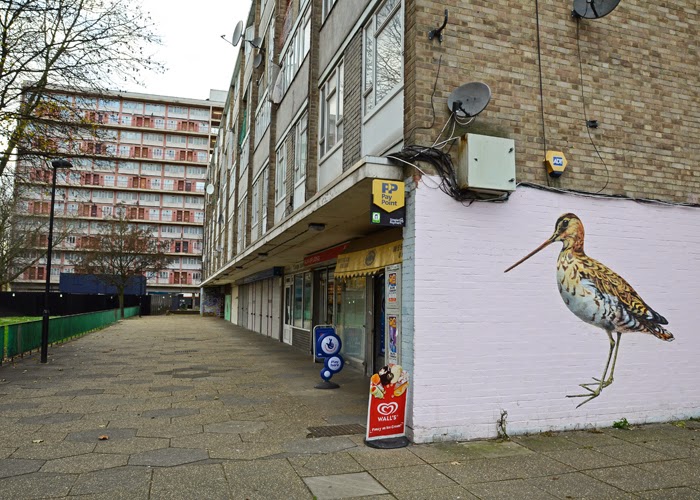
Street Art has been popularised in the last 15 years or so with major players, in particular “Banksy”, gaining status and recognition within the art world. Given my overriding interest in wildlife, and birds in particular, I was intrigued to read a couple of articles in the London press about some new works by a street artist, “ATM”, who paints hyper-realistic pictures of birds in urban areas, where these species would once have lived before we took over their habitat.

Reading an article in the “London Metro” (16 December 2014) several of ATM’s comments struck a chord with me. He was brought up in the countryside, surrounded by the birds that he now depicts. When he went to art college “there was a greater emphasis on conceptual ideas and forging an original style, so making paintings of birds did not really fit in” (substituting “photographs” for “paintings, I know exactly what he means!). He now lives in London and his bright street paintings both liven up monotonous housing estates and act as a reminder of what we have lost throughout so much of the country, due to the way that we manage our land.


On Christmas Eve 2014 I visited the South Acton housing estate in West London, which is currently being re-developed and where much of his street art resides. With a little bit of searching I was able to find five of his works: a grey partridge (Image 1), a snipe (Image 2), a barn owl, a jay and a goldfinch.


Image 1

Image 2

Whilst the artwork itself provides a very straight, detailed and accurate description of the birds themselves, the locations and the difficulties of transcribing the works onto surfaces having differing textures and shapes provide, for me at least, conceptual art. The paintings have received a very positive response from locals and, as ATM points out, “their appeal goes across age and social barriers”. I have tried to illustrate the street art (Images 1 and 2) within its environment, just as I would if photographing the birds themselves.

The goldfinch (Image 3) and the Jay were painted in a school playground, which I was lucky enough to be able to access when I visited. Here, ATM deliberately painted birds which still occur within the area and I was delighted to hear the twittering of goldfinches in a tree that was adjacent to the goldfinch painting. Hopefully the art will encourage the next generation to look after the wildlife that we still have in our urban environment, as well as to take action to prevent the complete disappearance of species, such as the grey partridge and snipe, from our countryside.

Image 3

I am looking at ways to incorporate the concepts behind this street art into my own work, be it for my current major project or beyond.


Exhibition Visit: "Conflict - Time - Photography" (Tate Modern, London)

(Viewed 13 December 2014)

“Conflict – Time – Photography” is a major group exhibition, marking the 100th anniversary of the start of the First World War. Essentially, the exhibition deals with the role of the camera in documenting the aftermath of war, or at least the aftermath of conflict action, and the uses to which that documentation can be put. In many cases the chosen photographers visited sites of conflict after the conflict ended and used their cameras to make personal statements about the effects of war, to apportion blame, to express their own feelings on the subject of conflict or simply to document the destruction, to lives and human structures, caused by war and conflict.


The exhibition deals with conflict from the time of the Crimean War (with photographs by Roger Fenton, who is widely regarded as being the first war photo-journalist) to the present day (Syria, Iraq, Afghanistan). However, its unique curatorial selling point is that the exhibits are ordered not by date, but by the amount of time that elapsed between the occurrence of the conflict or skirmish and the recording of each photograph. Toshio Fukada’s images of the mushroom cloud, taken less than twenty minutes after the explosion of the atomic bomb at Hiroshima, are therefore in the first gallery, whilst Chloe Dewe Mathews’ photographs of execution sites of World War 1 deserters, taken almost 100 years after the executions (about which more later), occupy the final gallery.

 Don McCullin’s famous photograph of a shell-shocked US marine, taken moments after he had been involved in battle during the “Tet Offensive” in Vietnam, hints in the first gallery of a photo-journalistic element to the exhibition. However this memorable image, still powerful today, proves to be a diversion. For the most part the exhibition features fields, buildings or the remains of buildings in the aftermath of war. Sometimes, particularly in the later galleries, there is little or no evidence from the images that conflict has occurred: it is necessary to peruse the accompanying text to understand the significance of the photographs. People are largely absent, even in the immediate aftermath of conflict (such as in Luc Delahaye’s memorable photograph of an Iraqi street in Ramadi moments after the explosion of an “improvised explosive device”, where a dust cloud all but obscures the shell of a crippled armoured car). Richard Peter’s starkly beautiful reminder of the horrific damage to the city of Dresden caused by Allied bombing (Image 1) also features no people: only a statue presides over the ruins of a once great city.

Image 1 (Richard Peter)

Peter’s photograph is a brilliant example of how a single image can arouse horror and outrage about the brutality of war. Likewise, Shomei Tomatsu’s simple photograph of a watch recovered from the ruins of Nagasaki, showing the exact moment of the explosion (11.02 am on 9 August 1945; Image 2), together with the image of a military helmet with a fragment of bone fused inside and many photographs of scarred survivors (all featuring in a book published 21 years after the explosion), are just part of a large section of the exhibition devoted to how Japanese citizens and photographers coped, or failed to cope with the horrific aftermath of the atomic bombs at Hiroshima and Nagasaki.

Image 2 (Shomei Tomatsu)

These examples demonstrate the power of the photograph, both as a documentary tool and as a vehicle to stir emotions; to learn lessons and to appreciate the vulgarity, brutality and pointlessness of conflict. However, as the exhibition progresses and the distance in time from the conflict increases, the impact becomes more muted. Straight documentary and direct propaganda are replaced by conceptual works, such as Taryn Simon’s attempts to document the living descendants of Hans Frank, Hitler’s personal legal adviser (not surprisingly, many of these descendants refused to have anything to do with her project, which therefore included many blank frames in addition to a handful of photographs of living descendants or items of clothing sent by those who co-operated but did not wish to be photographed). Frank was executed following the Nuremberg war trials in 1946. It is estimated that he contributed to the deaths of over five million people, but I fail to see the point of involving people, who simply had the misfortune to be born into Frank’s family, in this work. Stephen Shore, well known for his “ordinary” photographs, travelled to Ukraine in 2012-13 to photograph the last remaining Ukrainian holocaust survivors, their everyday surroundings and belongings. Three million Ukrainians were killed by the Nazis during the Second World War: Shore's photographs, whilst mainly featuring everyday details of the survivors’ lives, do at least transport us to a different world. However, a group of photographs alone cannot explain to us the horrors that were endured by these proud, elderly people.

The final room of the exhibition contains a series of (mainly) landscape photographs by Chloe Dewe Mathews, entitled “Shot at Dawn”. In 2013, 99 years after the commencement of the First World War, Mathews was commissioned to find and photograph the sites where British, French and Belgian soldiers were executed for cowardice and desertion on the Western Front. Rarely can such an emotionally-charged subject have produced such a bland and forgettable series of images! The sites were photographed at dawn, the time when the soldiers would have been shot. We see uninteresting fragments of woods, picnic sites and pancake-flat never-ending fields and ditches (for example, see Image 3). Whether the deserters’ relatives benefit today from knowing where their loved ones were shot is open to question. Could the fields and ditches be haunted with the memories of the dead soldiers? I doubt it. My belief is that Mathews was on to an artistic “loser” when she took on this project and her photographs represent a rather limp end to the exhibition. However, there is no excuse for offering a book of her photographs, complete with many blank pages, for £45 in the exhibition shop!

Image 3 (Chloe Dewe Mathews)

Overall, this is an interesting and contemplative exhibition, dealing with the aftermath of conflict. The power of the photograph to demonstrate the destruction caused by conflict is amply demonstrated, even though the documentation of battle is largely avoided. The different ways in which the aftermath of war has been documented and then used to create photographic art by conceptual photographic artists provide an interesting, if uneven counterpoint to the exhibition. Perhaps time really does heal wounds, both physically and metaphorically, because the works in the later exhibition rooms generally lack the impact of the earlier works. Maybe we should act in the immediate aftermath of war to stop it happening in future: if we wait too long memories will fade, the impact of war will become muted and the mistakes that bring war upon us will happen all over again.


Friday, 12 December 2014

The British Journal of Photography and Conceptual Art

The British Journal of Photography (BJP) appears to be by far the most widely read journal of practitioners of photographic art, OCA tutors and, indeed, OCA students in the UK. Having purchased the odd copy in 2013 and the first half of 2014 I finally decided to take the plunge and take out a year’s subscription in July 2014 (kindly paid for by my partner, as a birthday present). In this article I will give some early personal  impressions of the magazine and its content.

The magazine is aimed fairly and squarely at those who have a strong interest in and/or make a living from photographic art. Following the editorial comment, news and some notes on current or forthcoming exhibitions that would be of interest to its readership the magazine gives space to selected projects by (often) young, perhaps unknown photographers, allowing them to explain their work.  The bulk of the magazine then involves more detailed, lavishly illustrated articles about established photographers, usually featuring their new projects in exhibition and/or book form. This work has an international flavour, includes articles about photographic “collectives” and looks retrospectively on occasion, as well as crystal ball gazing into the future. The features often tie in with current exhibitions, in the UK or in Europe. Finally there is a short review section on new technology, with a few adverts right at the back.

There is a strong emphasis on portraiture (human, of course: wildlife doesn’t get a look in in this magazine) and social documentary in the BJP. Indeed, the November 2014 issue had a “contemporary portraiture” theme throughout and the two most recent issues (November 2014 and December 2014 / January 2015) have both featured portraits on their covers. Other “trending” areas have included photobooks and photographs taken from drones. In many ways the BJP reminds me of the music magazines (Melody Maker, NME) that I used to read in the early 1970s: latching on to fresh and exciting new ideas and talent (in musical terms, the artists’ first album), building the artists up then following their progress with interest (that “difficult” second album), but losing interest (or knocking them down, in the case of the music press) if the artists’ creativity lapses or they go “mainstream”. To be fair, the BJP does not review or pass judgement on the artists’ work as such, but simply sponsors their work by giving them space. However, it can pick and choose (we assume!) whose art to feature and whose art is not creative or original enough for the magazine. Damning reviews are not evident, although there were harsh words in the editorial of the November issue for the lack of originality of some of the work selected for display at the Taylor Wessing Portrait Prize exhibition (with which I concur: see my own exhibition review).

The work featured in the BJP is very strongly concept driven, featuring portfolios rather than individual images (the exception being images taken by photographers in themed exhibitions, where work by different photographers relates to the same subject, place and/or period of time). I found it useful to study the concepts behind the projects. Many related to the personal interests (often socio-documentary) of the photographers, although a few were born of chance discoveries whilst working on an entirely different project. Since my own personal projects reflect these two sources of inspiration I was encouraged in the belief that my photographic output, whilst markedly different to that of the featured photographers, was driving me in the right direction.

Looking at the featured images gave me more of a problem. Some, such as Mayumi Hosokura’s individual images of nudes and neon-lit streets (BJP October 2014; pp20-21) are very attractive in their own right but don’t seem to work well together as a portfolio, whereas Travis Hodges’ portraits of “self-trackers” (BJP November 2014; pp18-19) are quite clearly linked and related to a common theme, but appear to be rather bland and uninspiring. Furthermore (and this is a problem that is very relevant to my own work), each of Hodges’ images needs text to explain its significance. Only rarely (such as in Otto Snoek’s photographs of the differences and similarities between the citizens of the European Nations: BJP November 2014; pp14-15) does a photographic Portfolio provide what, to my eyes at least, are interesting, appealing yet clearly linked images, even in the absence of text. Nevertheless, studying the project portfolios has given me a valuable insight into how to turn a concept into a project and subsequently into a portfolio of images.

Whilst the project work was most relevant to my own output the most interesting features were the retrospectives, such as Tom Seymour’s November 2014 report on the work of Danny Lyon, a New Yorker who captured some of the defining images of the 1960s Civil Rights Movement (based on Lyons’ recent memoirs, published as a book) or Seymour’s October 2014 look at the photographs of the paparazzi who recorded the glamour, politics and terror of Italy in the 1970s (featured as an exhibition at the 2014 Brighton Photo Biennial).

Somehow, the technology reviews at the back of the BJP seem out of context with the rest of the magazine; almost an anachronism. Are they a residue from the days before photography became recognized as an art form, when perhaps BJP occupied a niche not quite so distantly removed from magazines such as “Professional Photographer”? How many readers find the reviews to be of use? Not many, I suspect. Nowadays it is possible to buy bulky magazines completely dedicated to reviewing and comparing camera hardware, whilst BJP is extremely selective, sometimes reviewing just one piece of equipment in a given issue. Having said that, I did find the review of Nikon’s D810 full-frame DSLR of value: the positive review has, along with others, elevated this camera to the top of my list of hardware to buy……..when funds allow!

In summary, the BJP provides me with a useful glimpse into the world of conceptual photographic art and its practitioners. Whereas I must admit that many of the featured images and portfolios of images have, at best, limited aesthetic appeal to me the work on display is of value in providing an insight into how to develop a photographic idea, from its inception to the finished article. Furthermore, I am enjoying reading some of the historical features in the magazine. I will renew my subscription in 2015, even though I’ll have to pay for it myself!

Exhibition Visit: Wildlife Photographer of the Year 2014 (Natural History Museum, London; visited 29 November 2014)

The Wildlife Photographer of the Year (WPOTY) Competition is one of the biggest photographic competitions in the world, this year attracting over 41,000 entries from photographers in 96 different countries. The universal nature of the competition attracts the top professionals, although occasionally talented amateurs can win the big prizes. There are nearly 20 entry categories, ranging from the obvious “mammals” and “birds” to sections such as “natural design” and “the world in our hands”. There are three age group categories for young wildlife photographers, who produce some amazing entries although one always wonders how much influence their parents had on the conception and processing of their images: certainly some of the cameras that they use are well beyond the means of most young people! As always, the exhibition was held at the Natural History Museum, with the 100 winning entries on display. These included the three winners in a new time lapse photography award, each sequence of still images being played on a 45 to 60 second loop.

This exhibition continues to be very popular. When we visited, late on a Saturday afternoon, it was extremely difficult to get close enough to the printed images to see fine detail, because the room was so crowded. Despite entry being allowed using timed tickets there were hordes of people milling around in the room. Although ignored by the photographic art community (see my essay: Assignment 3) there is no doubt that the wildlife photography genre is hugely popular with the general public, large numbers of whom would have paid good money to access this exhibition. The youthfulness of the audience also hints at a bright future for the genre.

So what of the exhibits? Well, there was as usual a decent representation of big cats and primates, as well as some predictably stunning avian photographs, such as Jan van der Greef’s amazing portrait of an Ecuadorian sword-billed hummingbird, apparently about to stab a collared inca hummingbird (Image 1). He used a battery of flashlights and other equipment to capture this extraordinary result. The photograph emphasises one aspect of the wildlife photographer’s psyche, which is also common to sports photographers: to try to go one step further than everybody else, to capture the very best photograph, no matter how long it takes or at what cost.


Image 1 (Jan Van Der Greef)

Is there any evidence for concept-driven photography in the exhibition? Well, Bence Mate’s attempt to produce a nocturnal photograph of herons at a lake, with “The Plough” (part of the Ursa Major constellation) visible both in the sky and as a reflection in the lake, was produced only after spending 74 nights in a hide (whether he was carrying out other photographic projects as well during this extensive period is not made clear: one certainly hopes so)! His reward was to win the “Birds” category. Brent Stirton again won the Wildlife Photojournalist Award for his six image portfolio, which highlights some of the ways in which humans regard and utilize lions, with particular emphasis on “canned lion” hunting. Stirton’s stories never shirk on the gory details, but they are invariably beautifully composed: this is photo-journalism of the highest quality, but I would not necessarily call it concept driven; nor would I call it art.

My favourite photographs at the WPOTY exhibition invariably include abstracts and there were some very fine examples on display here. Herfried Marek’s print of three pond skaters in a forest pond (Image 2) is a beautiful example, as is Juan Jesus Gonzalez Ahumada’s elegant black and white composition of a spider on the skeleton of a prickly pear leaf (Image 3). However, my favourite abstract, by the same photographer, was of the warm light of a controlled fire seen through the cracks of an old agave leaf (Image 4). Now, why didn’t I think of producing that kind of image?

Image 2 (Herfried Marek)

Image 3 (Juan Ahumada)

Image 4 (Juan Ahumada)

The time lapse sequences proved very popular, with the three winning entries being displayed on screens at one end of the exhibition room. Of course it is not (yet!) possible to transfer these sequences to the printed page, so a visit to the exhibition is essential to appreciate their dynamism. I wonder how long it will be before video makes an appearance in the competition categories. Finally, in an exhibition which emphasizes the beauty of the natural world, Herfried Marek’s image of a birch tree, in the aftermath of an autumn snowstorm (Image 5), is a fitting emblem of the exhibition’s aims.

Image 5 (Herfried Marek)

Once again this competition provides awe-inspiring natural history photography of the very highest order. Whilst this type of photography has only limited relevance to my OCA course it is nevertheless inspirational, appealing to the soul rather than to the mind. In contrast to most of the exhibitions that I have visited and commented on in my logbook there is no underlying theme connecting the images; in most cases each photograph stands on its own as a “one off”, intended to have an emotional impact on the viewer.

The exhibition not only emphasizes the beauty of the natural world but also its fragility. My hope is that it will inspire some visitors to become the future guardians of this planet’s environment and inspire others to publicize the wonder of our natural surroundings through their photographic output.